UW Health Nurses Fight for Union Representation
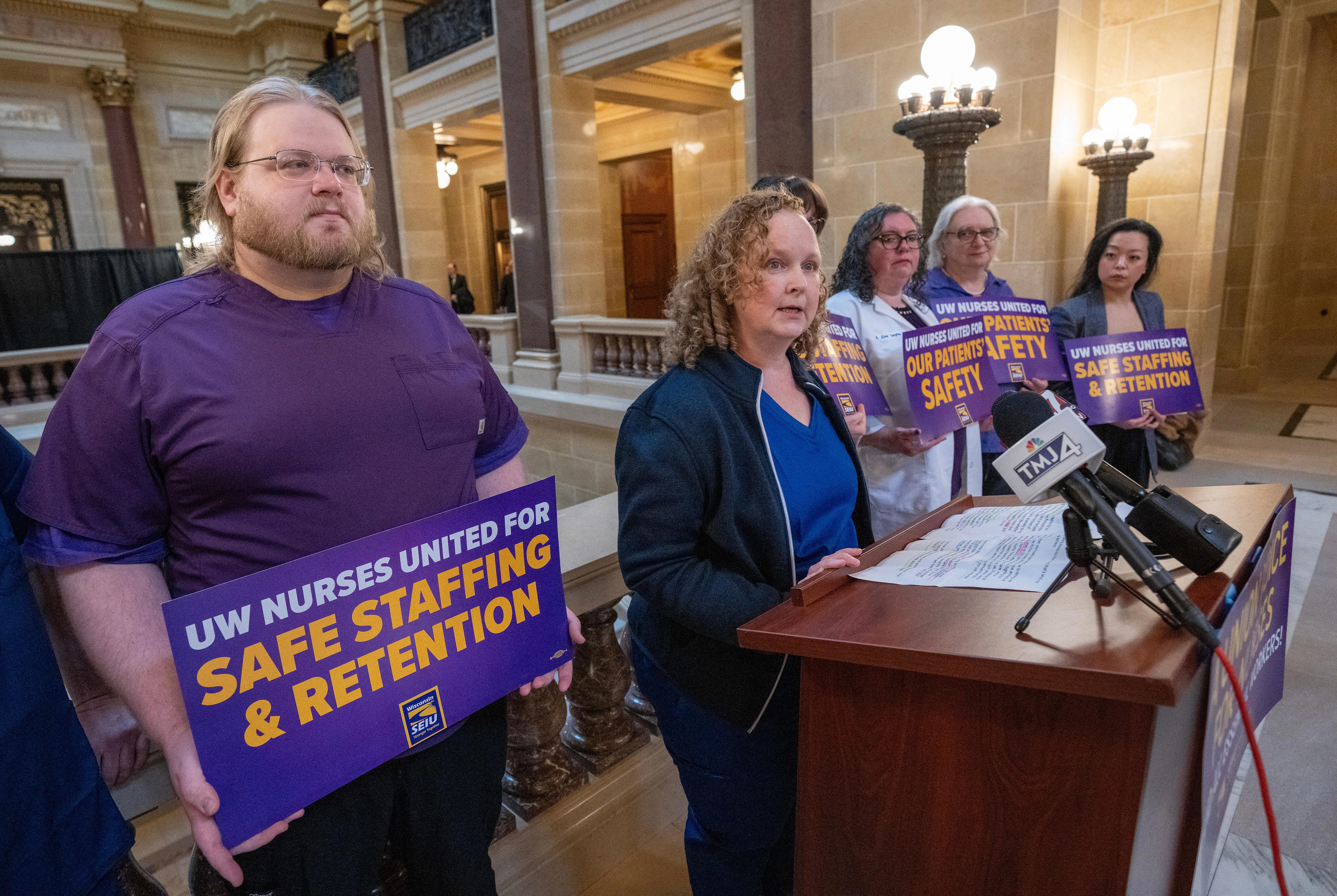
A Night Shift and a Fight for Representation
On June 27, I did something I never do — I stayed up until 8:30 a.m. As a registered nurse at UW Health University Hospital, I usually head straight to bed after finishing a 7 p.m. to 7 a.m. night shift. But that morning I stayed awake because an important court ruling that would affect UW Health nurses was due. This decision, by the Wisconsin Supreme Court, would determine whether our union would have the right to collectively bargain under Wisconsin's Employment Peace Act, a law that gives private sector workers here the right to collectively bargain.
The Wisconsin Supreme Court ruled against us. While disappointing, this setback won't stop us from fighting for our seat at the table.
Legal Limbo for Nurses
For more than 14 years, UW Health nurses have been stuck in legal limbo when it comes to our right to organize and collectively bargain. We keep going because we love being UW Health nurses. We're proud to work at Wisconsin's flagship teaching hospital, and we want to make it the best possible place for our patients and community.
Our experience illustrates something larger that is happening among working people across America. Even as the systems meant to empower us are breaking down, we're finding new ways to claim our place at the table.
The Power of Solidarity
Growing numbers of working people across America want respect for our work and a more secure future. Unions give us the power of numbers to advocate for the good jobs that build thriving communities. Public support for unions is at its highest level in decades, yet fewer American workers can actually navigate our complex legal system to join unions and negotiate contracts.
The laws meant to give workers the freedom to organize together are not working. Corporate lobbyists have used their money and influence to weaken our rights. Corporate lawyers throw up barriers to make starting a union time-consuming and expensive.
A recent MIT-led report confirmed what we already know: "the decrease in unionization—despite the interest in it—is likely due to current labor laws, which often make unionization difficult, as well as resistance from employers."
But working people are proving we can be creative and persistent despite these obstacles. From baristas organizing at Starbucks to warehouse workers at Amazon, from Group Health Cooperative clinic workers here in Madison to rideshare drivers nationwide, we're building solidarity and standing up against corporate pushback.
A History of Resistance
Despite Walker's attacks, our union didn't disappear. It wasn't always this hard. At UW Health, nurses had a union and bargaining rights for many years. UW nurses first organized in the 1960s, negotiated contracts, and built constructive relationships with hospital administrators.
But in 2011, former Gov. Scott Walker attacked working Wisconsinites and our unions, stripping union rights from tens of thousands of people. In 2014, when our existing contract expired, UW Health administration withdrew legal recognition for our union.
Our union didn't disappear. When I started at UW Health in 2017, I helped rebuild the union my colleagues had kept alive. Since then, I've supported every effort to restore our collective bargaining rights. Because UW Health is state-supported, we tried negotiating under Wisconsin's law for public employees. Denied. Since UW Health acts like a private employer in many ways, we tried winning recognition under federal law for private sector workers. Denied. Last week, the Wisconsin Supreme Court denied that we have rights under state law for private sector workers.
Progress Through Persistence
Despite these legal setbacks, we used our strength in numbers to push forward. In 2022, my fellow nurses and I voted to authorize a strike over staffing and COVID-19 burnout. Our administration responded by agreeing to a "Meet and Discuss" process that gives frontline nurses input into hospital policies. We recently agreed to extend this process for at least two more years. It's not the full collective bargaining we deserve, but it's progress.
A Call to Action
UW Health nurses will keep going until we restore our right to collectively bargain. One of my heroes, the Jesuit priest, poet, and activist Daniel Berrigan used to say, "If you want to be hopeful, do hopeful things." For me, that means organizing with the power we already have to win back the rights we deserve.
We know that when healthcare workers have a voice, patient care improves. When we can negotiate for safe staffing and create sustainable careers, everyone benefits.
The question isn't whether American workers want unions — we clearly do. The question is how quickly we can build the power to rewrite the rules so working people can win the future we have earned.
Colin Gillis is a Registered Nurse at University Hospital and a leader of UW Nurses United of SEIU Wisconsin, a union of healthcare workers in Wisconsin.

Post a Comment for "UW Health Nurses Fight for Union Representation"
Post a Comment