Radiotherapy Breakthrough: Enhancing Cancer Care with Existing Equipment
Advancements in Proton Therapy: A New Approach to Radiation Quality
Modern radiotherapy techniques have the potential to significantly improve cancer treatment outcomes by focusing on the quality of therapeutic proton beams. Recent breakthroughs by physicists from the Institute of Nuclear Physics of the Polish Academy of Sciences in Cracow are bringing this vision closer to reality. Their research, published in the journal Physics in Medicine & Biology, highlights a novel method that could enhance both the effectiveness and safety of cancer treatments.
In today’s medical landscape, improving cancer treatment often involves investing in advanced irradiation equipment. For proton therapy, this can cost tens of millions of euros. However, a team of researchers at the Cyclotron Center Bronowice (CCB) has developed an innovative approach that leverages existing equipment to achieve better results at a fraction of the cost. This solution allows medical physicists to assess the quality of proton beams during treatment planning, a parameter that has been overlooked in clinical practice until now.
Dr. Jan Gajewski, a researcher at IFJ PAN, explains that considering the quality of the radiation beam enables more precise determination of its biological effects. “By taking into account the quality of the proton beam, we can destroy cancer cells more effectively while minimizing damage to healthy tissues,” he says. The team’s work demonstrates that a practical and cost-effective method for verifying radiation quality is now available.
The use of proton therapy is still limited compared to traditional photon-based treatments. While photons are widely used, only a small number of patients benefit from proton therapy. This disparity stems from the unique properties of protons, which deposit most of their energy at the end of their path within the body. This makes them particularly effective for targeting tumors while sparing surrounding healthy tissue.
However, the challenge lies in accurately measuring the quality of the proton beam during treatment. The linear energy transfer (LET) parameter is crucial in determining how much energy a particle deposits along its path. For photons, this value remains consistent, but protons behave differently as they slow down. Current treatment planning software can incorporate LET, but there is a lack of tools to verify it directly in clinical settings.
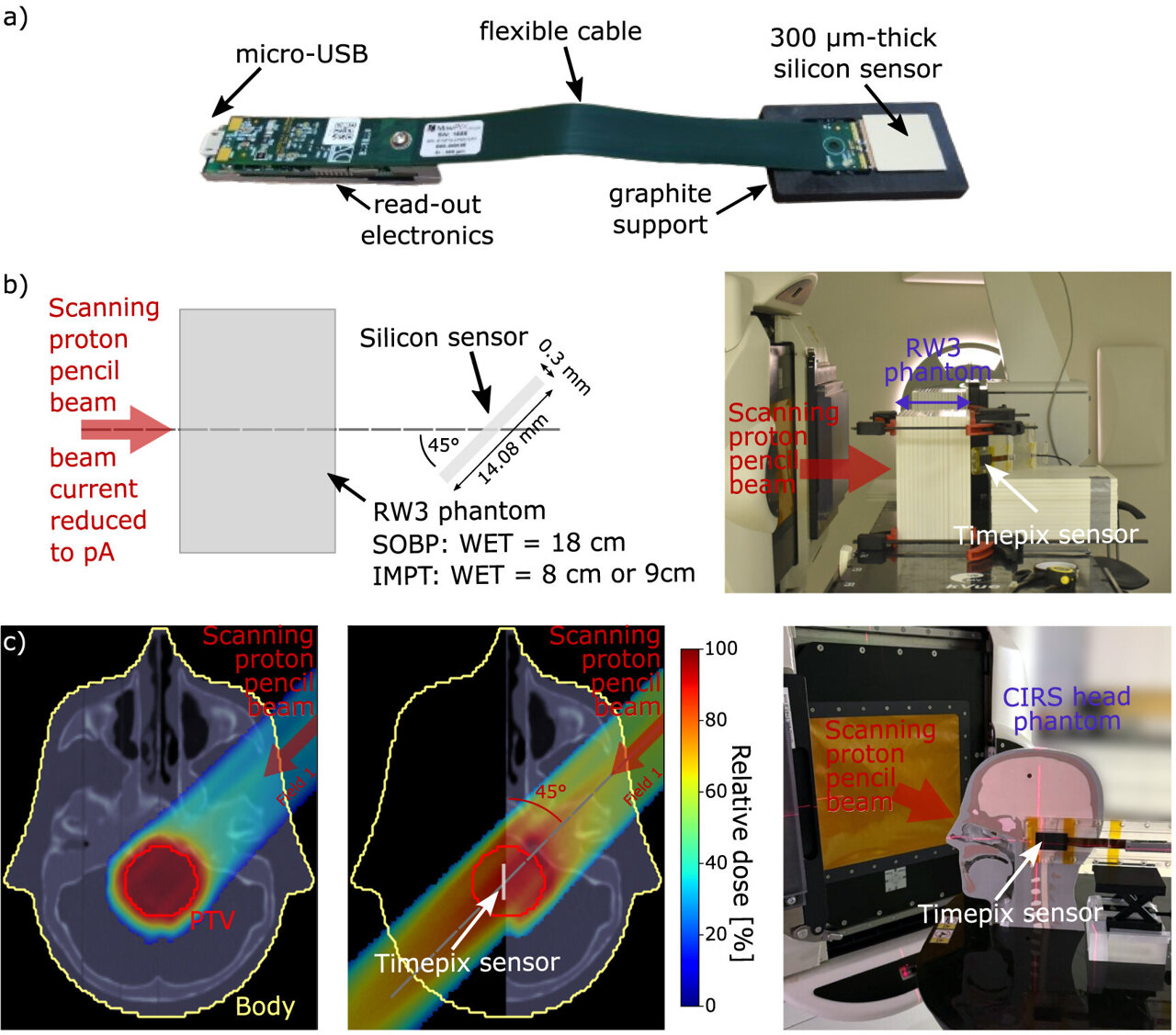
To address this gap, researchers at CCB used a commercially available Timepix3 detector to characterize the LET parameter. This detector, developed through the Medipix3 Collaboration at CERN, offers a compact and efficient way to measure radiation quality. The device features a 300-micrometer thick silicon sensor and a 256 by 256 pixel matrix, allowing for detailed tracking of individual particles. By applying artificial intelligence methods, the team was able to identify protons and estimate their LET values under therapeutic conditions.
Despite these advancements, a technical challenge remains. Modern cyclotrons produce high-intensity beams, while the Timepix detectors require low-intensity beams. However, this issue can be resolved with software updates from cyclotron manufacturers. Dr. Antoni Ruciński, a professor at IFJ PAN, emphasizes that the proposed method represents a significant step forward. “For the first time, we can speak of a practically ready-to-implement method of measuring radiation quality directly in proton therapy facilities,” he states.
This innovation has the potential to enhance the efficiency and safety of proton therapy and other advanced irradiation methods using helium, carbon, or oxygen ion beams. The research, supported by the LIDER XII grant from the National Centre for Research and Development in Poland, marks a critical milestone in the evolution of cancer treatment.
As the field continues to advance, the integration of new measurement techniques will play a vital role in improving patient outcomes. By leveraging cutting-edge technology and scientific collaboration, researchers are paving the way for more personalized and effective cancer therapies.

Post a Comment for "Radiotherapy Breakthrough: Enhancing Cancer Care with Existing Equipment"
Post a Comment