New Plant Pathway Reveals Cell Detoxification Under Light Stress
Understanding the New Pathway in Plant Processes
A newly discovered pathway in a plant process could significantly benefit farmers by enabling them to grow more successful crops, especially in regions where harsh environmental conditions, such as high light intensity, stress plants. This breakthrough offers insights into how plants manage their internal chemical processes under challenging circumstances.
The discovery complements the main workflow of photorespiration, suggesting that this process is more adaptable than previously thought. Xiaotong Jiang, a post-doctoral fellow in Jianping Hu's lab at the Michigan State University-Department of Energy Plant Research Laboratory, and her colleagues published their findings in the journal Nature Communications.
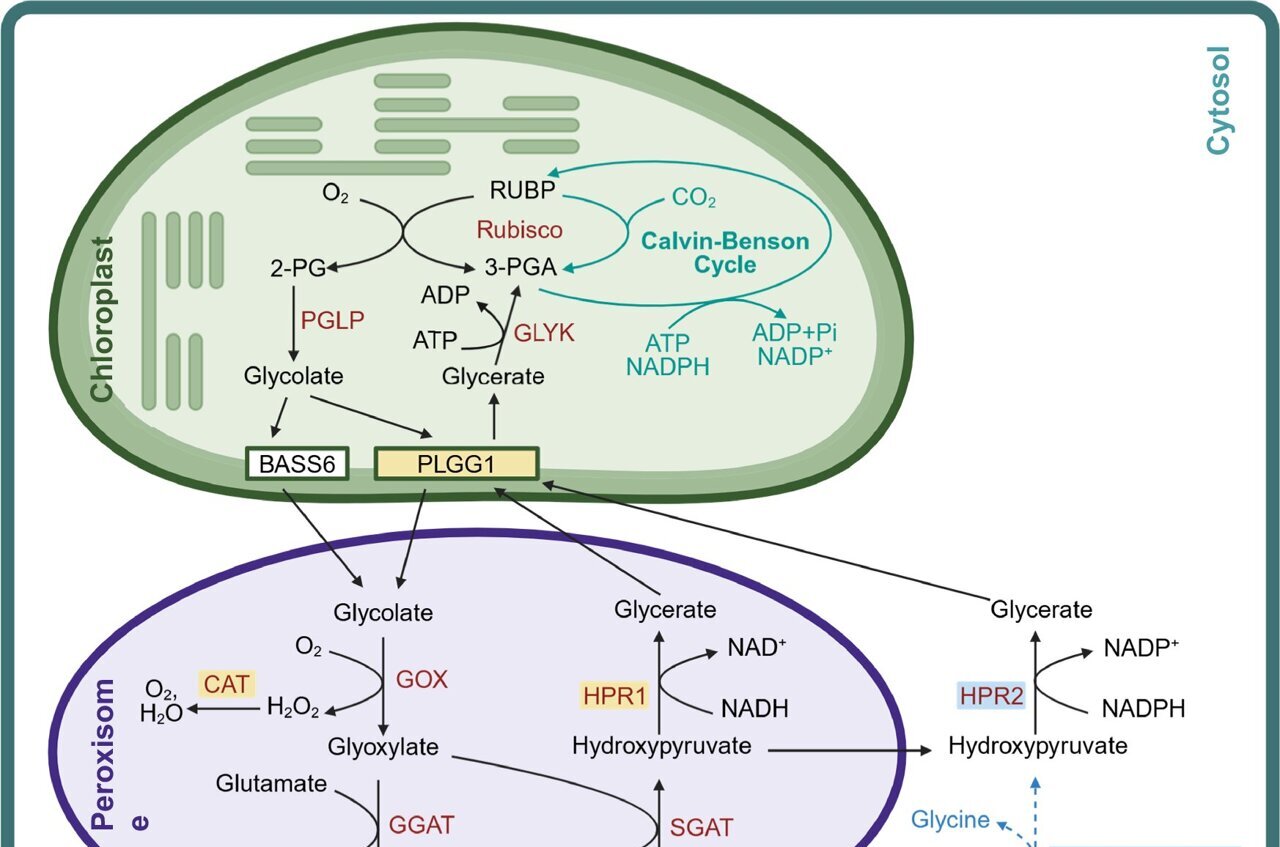
Photorespiration works alongside photosynthesis, acting like a cleanup crew when the precursor to photosynthesis creates harmful byproducts. Typically, the primary enzyme involved in photosynthesis, Rubisco, functions as a carboxylase that fixes carbon dioxide to make sugar. However, it can also act as an oxygenase, fixing oxygen instead. When this occurs, the process produces a chemical that is harmful to the cell.
To prevent this harmful chemical from accumulating, photorespiration steps in to process it into something less volatile that can be reused in photosynthesis. Jiang and her team found that under stressful conditions, plants can take a different approach.
While researching photorespiration for her Ph.D. thesis in the Hu lab, Jiang experimented with a lab-made mutant of the common research plant Arabidopsis thaliana. This mutant lacked the ability to produce a key photorespiration enzyme, hydroxypyruvate reductase 1, or HPR1. When grown in a high-light environment, these plants struggled to keep up with non-mutant plants.
To understand what was happening inside those plants, the team worked backwards by introducing random mutations in addition to the broken HPR1 and observed which plants improved. They then identified which genes—and the enzymes they code for—could compensate for the faulty HPR1 enzyme.
They found that disabling the enzyme glyoxylate reductase 1, or GLYR1, activates a parallel pathway involving HPR1’s relative, HPR2, which the researchers call a cytosolic glyoxylate shunt. GLYR1 normally converts glyoxylate to glycolate, but when it is turned off, glyoxylate builds up and is converted into hydroxypyruvate, then into glycerate by another enzyme. These two enzymatic steps also occur in the main photorespiration process. However, the shunt takes place in the cytosol of the cell, whereas similar steps in the main photorespiration pathway occur in peroxisomes.
Jiang describes the shunt as a highway detour, where cars (cytotoxic chemicals) are moving along a damaged road (the photorespiration pathway). "If the road is broken, a lot of cars may get stuck in their parking lots," she said. "If there's an alternative way to go, then the cars can keep moving."
"A really important takeaway from this work is that photorespiration is quite flexible," said Amanda Koenig, a post-doctoral fellow in the Hu lab at MSU-DOE Plant Research Lab and co-author of the paper. When the main pathway is compromised for some reason, the complementary pathway can aid in processing cytotoxins.
"This parallel pathway may have a lot of potential for improving energy efficiency and crop yield without compromising their resilience to stress conditions."
Although the team focused on high light conditions specifically, Jiang mentioned that the pathway could be beneficial in other stressful situations—but further research is needed to confirm this.
More information: Xiaotong Jiang et al, A cytosolic glyoxylate shunt complements the canonical photorespiratory pathway in Arabidopsis, Nature Communications (2025). DOI: 10.1038/s41467-025-59349-2 Provided by Michigan State University

Post a Comment for "New Plant Pathway Reveals Cell Detoxification Under Light Stress"
Post a Comment